Sultanhanı Caravanserai in Aksaray is one of the strongest surviving expressions of Seljuk road architecture in Anatolia. Built during the reign of Sultan Alaeddin Keykubad I in 1229, it combines a monumental carved portal, an open summer courtyard, a raised kiosk mosque and a vast covered winter hall.
The pleasure of Sultanhanı is spatial: pass through the decorated portal, cross the bright courtyard and then enter the dark, vaulted winter hall.
What was a caravanserai?
Caravanserais were fortified stopping places on long-distance trade routes. They offered shelter for travellers, animals and goods while helping states support movement across difficult territory. They were practical infrastructure as much as ceremonial architecture.
Sultanhanı stood on an important central Anatolian route between commercial centres. Its scale reflects the value placed on secure travel and trade during the Seljuk period. Avoid imagining it as a modern hotel: accommodation, storage, worship, animal care and protection were organised within one defensive complex.
The building also carried a political message. A monumental state-supported inn made authority visible on the road: travellers encountered order, craftsmanship and protection far from a royal palace. That combination of infrastructure and representation is central to understanding Seljuk caravanserais.
The architecture to notice
The monumental portal
The entrance is framed by dense geometric carving and muqarnas, creating depth through repeated stone patterns. Step back before entering; the portal is designed to be read as a complete façade, not only as a doorway.
Notice how the decoration becomes increasingly intricate toward the opening. The contrast between the highly worked portal and the restrained outer walls focuses attention on the threshold, turning arrival into a carefully staged architectural moment.
The open courtyard and kiosk mosque
The courtyard served the warmer-season functions of the caravanserai. At its centre, the small mosque is raised on arches, a distinctive feature that keeps it visible and physically separate from the busy ground level.
The covered winter hall
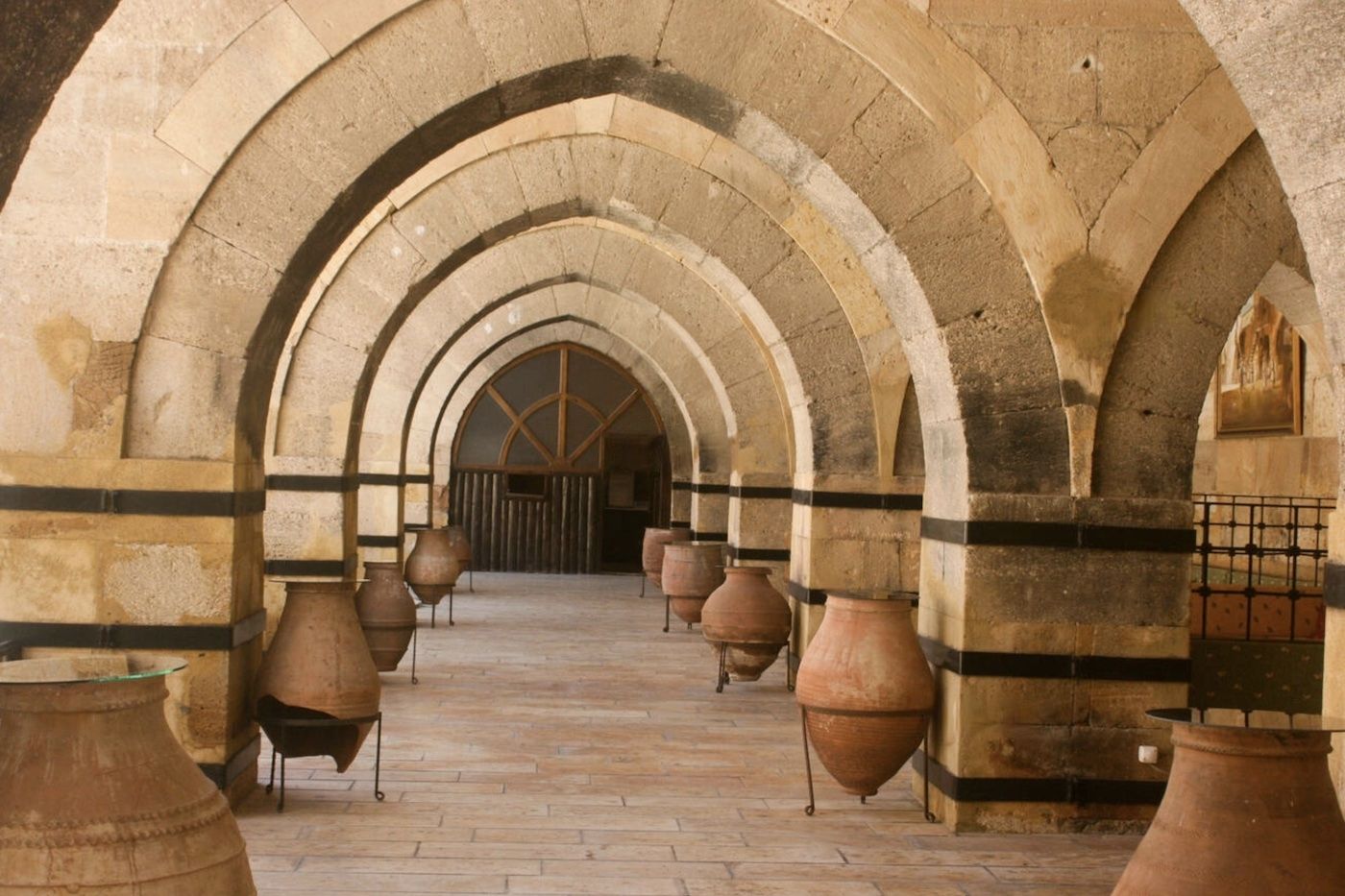
The enclosed section changes the mood completely. Heavy piers and vaults create a protected interior for cold conditions, while limited openings control light and weather. Give your eyes time to adjust before photographing the space.
The hall's scale becomes clearer from the central axis, where the repeated bays lead the eye toward the far end. Side spaces are less dramatic in photographs but are essential for understanding how people, animals and cargo could be sheltered together.
Service spaces and circulation
Rooms and arcades around the courtyard supported storage, rest and daily needs. Look at how people, pack animals and goods could move from the entrance toward sheltered areas without losing the security of the perimeter.
Stone, climate and seasonal use
The open and covered sections are a direct response to central Anatolia's climate. Summer activity could spread around the courtyard, while winter required a compact protected interior. Thick masonry, controlled openings and vaulted construction helped moderate heat, cold and wind without modern systems.
How to experience the site
- Begin outside the portal and study the stonework from several distances.
- Cross the courtyard slowly and circle the raised mosque before entering the covered hall.
- Compare the bright summer court with the protected winter interior.
- Look for construction joints and repaired surfaces instead of assuming every stone belongs to one building phase.
- Allow roughly 45–60 minutes for an unhurried architectural visit.
Planning a day trip from Cappadocia
Sultanhanı lies beyond the central Cappadocia towns, on the Aksaray–Konya corridor. It makes most sense for travellers interested in Seljuk history or those already continuing toward Aksaray, Konya or Ihlara Valley. A dedicated round trip consumes a substantial part of the day, so do not describe it as a quick Göreme attraction.
A focused architecture visit and a valley hike demand different rhythms. If you combine them, decide in advance whether Sultanhanı is the main destination or a shorter stop. This prevents the common mistake of reaching Ihlara too late for the walk you expected to complete.
For route choices, travel times and driver logistics, use the transportation-focused guide on Cappadocia Taxi or check the live taxi fare calculator. Prices and road conditions should not be frozen into a historical article.
What to combine with Sultanhanı
- Aksaray: the practical regional centre and the natural junction for the route.
- Ihlara Valley: a major landscape and rock-cut heritage stop, but adding a hike creates a full day.
- Selime Monastery: a strong architectural pairing at the end of Ihlara Valley.
- Konya: suitable when Sultanhanı is part of an onward journey rather than a return to Göreme.
Practical tips
- Check current opening hours and access conditions before leaving Cappadocia.
- Carry water and sun protection; the courtyard is exposed.
- Wear stable shoes for uneven stone floors.
- Use morning or late-afternoon light for the entrance carvings.
- Treat the mosque and all historic surfaces respectfully; do not climb on architectural elements.
- Keep the schedule realistic if you also plan to walk in Ihlara Valley.
Frequently asked questions
Is Sultanhanı part of central Cappadocia?
It is in Aksaray Province, outside the Göreme–Ürgüp tourism core, but it fits naturally into the wider central Anatolian history surrounding Cappadocia.
Is it worth the drive?
Yes for travellers interested in Seljuk architecture, Silk Road infrastructure or onward travel toward Aksaray and Konya. For a short first visit focused only on valleys and cave churches, it may be too far.
Sources and editorial note
Construction date and architectural details were checked against the official GoTürkiye architectural guide and Aksaray destination guide. Changing tickets, hours and fares are intentionally not hardcoded.