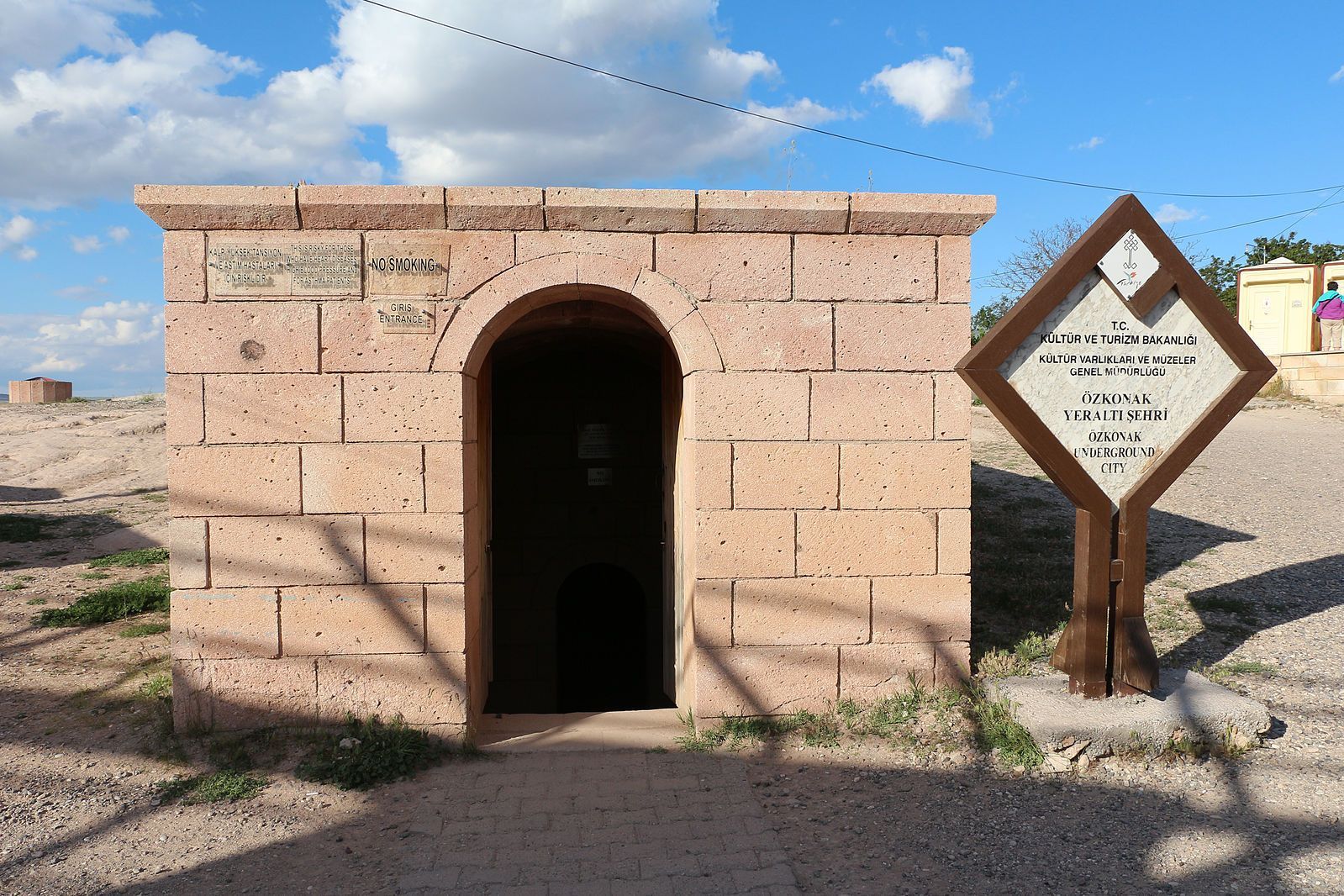
Most visitors to Cappadocia tick off Derinkuyu or Kaymaklı and consider the underground chapter closed. Yet tucked away near Avanos, roughly fifteen kilometres north of Göreme, lies Özkonak Underground City — a subterranean world every bit as extraordinary as its famous neighbours, and visited by a fraction of the crowds. If you have ever felt squeezed shoulder-to-shoulder in the narrow passages of Derinkuyu, wondering whether you are exploring ancient history or queuing for a theme-park ride, Özkonak is the antidote. Here, silence settles over the tunnels, torchlight catches carved stone walls without the press of groups, and the full weight of human ingenuity in the face of danger comes through far more clearly. This is Cappadocia's underground story told at a quieter, more intimate frequency.
History of Özkonak Underground City
Özkonak's existence remained largely unknown to the modern world until 1972, when a local farmer named Latif Acar noticed grain mysteriously disappearing through cracks in his field. Following the trail led him to an opening that descended into one of Cappadocia's most significant archaeological discoveries of the twentieth century. The city was subsequently excavated, studied, and opened to tourists, though it never attracted the commercial machinery that grew up around Derinkuyu and Kaymaklı.
Historians place the main phase of construction during the seventh and eighth centuries, a period when Arab raids swept repeatedly through Anatolia, forcing the region's early Christian communities to seek refuge underground. The volcanic tuff that defines Cappadocian geology proved a perfect medium — soft enough to carve with basic tools, yet stable enough to hold its shape for over a millennium. The result is a city that plunges approximately forty metres into the earth across ten floors, a subterranean settlement capable of sheltering up to sixty thousand people according to some estimates. Whether those numbers represent permanent residents or a temporary displaced population during siege conditions, the scale of ambition is staggering. Families, livestock, food stores, water supplies, and places of worship were all accommodated beneath a blanket of rock that left the surface above looking entirely undisturbed.
What Makes Özkonak Different
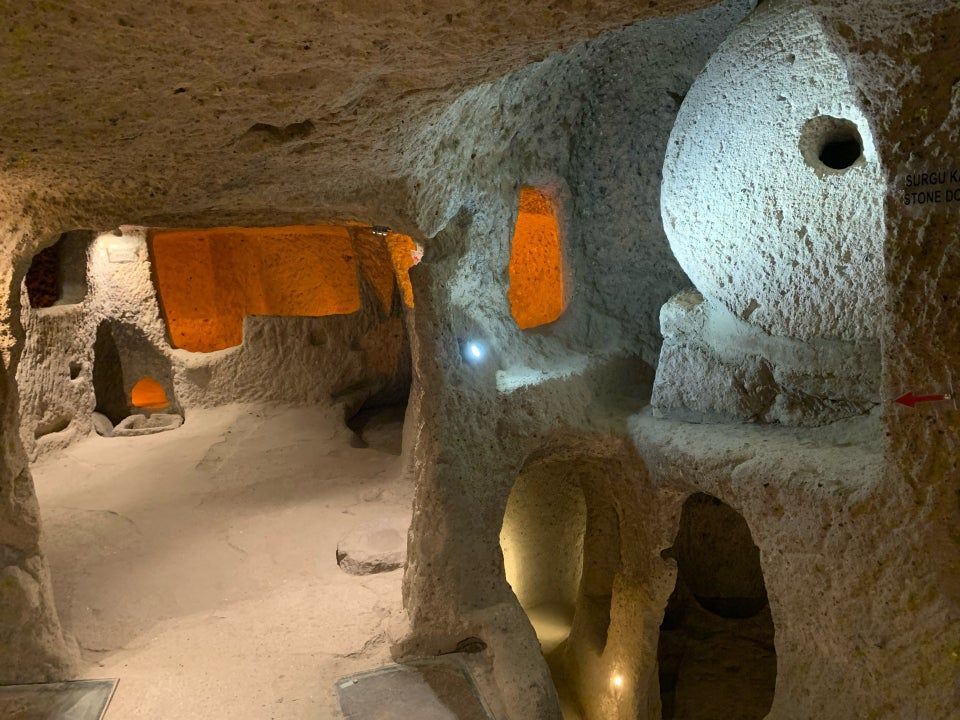
Every underground city in Cappadocia shares the same essential logic — descend to survive — but each has its own engineering personality. Özkonak's most distinctive feature is its rolling stone door mechanism, which differs meaningfully from the versions found at Derinkuyu. Here, the massive stone blocking wheels were designed to slide through vertical slots cut into the tunnel walls, a refinement that allowed defenders to seal a passage more precisely and, crucially, to communicate through small holes bored above the stone even while a corridor was locked shut. Those communication holes are perhaps the most human detail in the entire city: people barricaded in the dark, still finding a way to speak to one another.
Wine and olive oil storage tanks carved directly into the rock walls speak to a community that planned not just for survival but for sustained, organised living. These recesses were not temporary hiding spots; they were larders designed to sustain thousands of people across weeks or months of siege. The relative lack of tourist infrastructure at Özkonak — fewer barriers, fewer signs, less artificial lighting in some passages — preserves an atmosphere that more heavily visited sites have inevitably lost. You feel the roughness of the rock because you can actually touch it. You notice the ceiling height change because there is no one in front of you obscuring the view.
What You'll See Inside
Descending into Özkonak is a gradual adjustment — both physical and psychological. The main tunnel network branches and reconnects in ways that make it easy to understand how defenders could move laterally through the city while sealing individual corridors against intruders. Ventilation shafts rise vertically to the surface, narrow enough that you cannot pass through them but wide enough to keep the air below breathable, a feat of passive engineering that modern architects still admire. Cisterns and water channels ensured that even during a prolonged siege, residents would not be driven to the surface by thirst.
- Ventilation shafts: Vertical columns reaching the surface that supplied fresh air to all levels
- Cisterns and water channels: Carved reservoirs that made long-term underground habitation viable
- Dormitory spaces: Wide chambers where families would have slept during extended stays
- Rolling stone doors: The signature vertical-slot mechanism unique to Özkonak, with communication holes above
- Storage tanks: Deep recesses carved for wine, oil, and grain — provisions for weeks underground
- Communication corridors: Interconnecting passages allowing movement between levels without using the main tunnels
- Defence features: Narrowed chokepoints and trapping chambers designed to neutralise intruders one by one
Özkonak vs. Derinkuyu vs. Kaymaklı
Comparing Cappadocia's underground cities is less a question of which is best and more a question of what kind of experience you are after. Derinkuyu is the deepest and the most famous, plunging around sixty metres and offering the most dramatic sense of vertical scale. Its tourist infrastructure is well-developed, which means easier navigation but also significantly more foot traffic, particularly in summer. Kaymaklı has the largest accessible cross-section of tunnels open to visitors and the most polished visitor experience, with clear signage and a defined circuit — ideal if you want the underground city experience in its most approachable form.
Özkonak is for those who want something different. It is less polished, yes, and the accessible portions are smaller, but that is precisely the point. The absence of crowds allows you to linger at details — a storage niche, a ventilation column, a rolling stone door — without being swept forward by the current of a group. If you have already visited Derinkuyu or Kaymaklı, Özkonak provides genuine contrast: the same civilisation, the same extraordinary impulse to build downward, but experienced in something closer to solitude. For many travellers, it becomes the more memorable of the three.
Getting There from Göreme
Özkonak sits approximately fifteen kilometres north of Göreme, close to the town of Avanos on the Kızılırmak River. By taxi from Göreme the journey takes around twenty-five minutes, making it a comfortable half-morning visit. Dolmuş connections are possible via Avanos, though schedules require some planning — check locally for the latest timings. The natural pairing is a visit to Özkonak in the morning followed by an afternoon in Avanos, where the town's pottery workshops have operated continuously for centuries, the red clay of the Kızılırmak giving local ceramics their distinctive colour. It is one of those combinations that feels effortless and leaves you feeling like you have genuinely understood a corner of the region rather than simply ticked boxes. Get to Özkonak and combine with an Avanos pottery stop — check the Cappadocia taxi price calculator for live taxi fares from your location.
Practical Visitor Information
A small entry fee applies at the site; prices are set by local authorities and subject to seasonal adjustment, so it is worth confirming current rates before you go. The city is open throughout the year, but weekday mornings offer the best combination of light crowds and cooler tunnel temperatures. Even in the heat of a Cappadocian July, the underground maintains a year-round chill — bring a light jacket or layer regardless of the weather above ground. Closed, flat shoes are essential; the passage floors are uneven and occasionally damp, and sandals are genuinely impractical rather than just inadvisable. Travellers with claustrophobia should be aware that several corridors require crouching and some are narrow enough to feel genuinely confining. This is not a site that sanitises the underground experience — which is, depending on your temperament, either a warning or the strongest recommendation possible.
Frequently Asked Questions
Is Özkonak less crowded than Derinkuyu?
Significantly so. Derinkuyu and Kaymaklı draw the vast majority of underground city visitors in Cappadocia, partly due to proximity to route itineraries and partly through long-established reputation. Özkonak, situated near Avanos on the northern edge of the region, sees a fraction of that traffic. On a weekday morning it is common to have stretches of the tunnel network entirely to yourself — a rare experience in Cappadocia's peak season.
Can you visit Özkonak without a guide?
Yes. The site is accessible to independent visitors and the main circuit is navigable without a guide, though signage inside is limited compared to Derinkuyu or Kaymaklı. If you want deeper historical context — the engineering logic behind the rolling stone doors, the chronology of different construction phases, the daily life of residents — hiring a local guide for the day adds genuine value. Many Göreme-based guides can arrange this as part of a private day trip combining Özkonak with Avanos.
How deep is the Özkonak Underground City?
Özkonak extends approximately forty metres below the surface across ten levels. While this makes it shallower than Derinkuyu, which reaches around sixty metres, the depth is still considerable and the ventilation engineering required to make such a depth habitable remains impressive. Not all levels are currently open to the public; the accessible portion covers the upper floors where the main features — rolling stone doors, storage tanks, cisterns, and dormitory chambers — are concentrated.