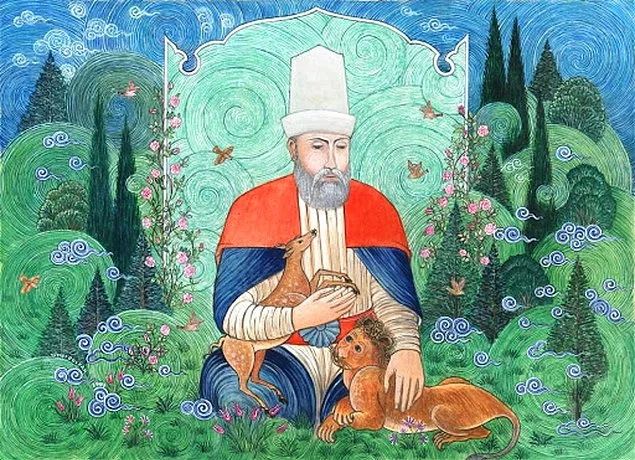
Roughly 45 kilometres northwest of Göreme, the quiet town of Hacıbektaş holds one of Anatolia's most resonant sacred sites. Here, in a former Sufi lodge turned museum, lies the tomb of Haji Bektash Veli — a 13th-century mystic whose teachings of love, equality and tolerance continue to shape the spiritual lives of millions. Whether you come as a pilgrim, a history enthusiast or simply a curious traveller, Hacıbektaş rewards the short detour from Cappadocia with rare depth.
Who Was Haji Bektash Veli?
Haji Bektash Veli was born around 1209 in Nishapur, in what is today northeastern Iran — a city that was, at the time, one of the great intellectual centres of the Islamic world. He received a thorough education in Islamic sciences before embarking on a long spiritual journey that eventually brought him to Anatolia, where he settled in the small village that would later bear his name.
His teachings drew on Islamic Sufism, but he wove into them strands of Anatolian folk belief, humanist ethics and an insistence on the equal worth of every human soul. In an era when rigid hierarchies governed nearly every aspect of life, Haji Bektash Veli preached that neither birth, nor gender, nor ethnic origin determined a person's spiritual standing. He is credited with founding the Bektashi Order, a Sufi brotherhood that would become one of the most influential religious movements in Anatolia and the broader Ottoman world.
The order's influence eventually extended into the Ottoman military. The Janissary corps — the elite infantry that formed the backbone of Ottoman armies for centuries — adopted the Bektashi tradition as their own spiritual framework, binding the order's fortunes to the very heart of imperial power. When the Janissaries were abolished in 1826, the Bektashi Order was officially suppressed, but its traditions survived among the Alevi-Bektashi community, today one of Turkey's largest spiritual communities.
His Philosophy and Legacy
The core of Haji Bektash Veli's thought can be distilled into a few striking principles, radical for their time and surprisingly resonant today. His most-quoted teaching holds that all human beings stand equal before God — a statement that carried enormous implications in a medieval society stratified by class, religion and gender.
- Gender equality: Haji Bektash Veli taught that women and men were equal in spiritual worth. Women participated openly in Bektashi ceremonies — a practice almost unheard of in 13th-century Muslim communities.
- Synthesis of traditions: Rather than rejecting Anatolian folk religion, he integrated its symbols and rituals into a broader Sufi framework, creating a distinctly local form of Islamic mysticism that felt native rather than imported.
- Emphasis on inner knowledge: For Bektashis, the outward forms of religion mattered less than sincerity of heart. This inward focus allowed the tradition to coexist — sometimes uneasily — with more orthodox currents in Islam.
- Turkish humanism: Modern Turkish thinkers, particularly those associated with the early republic's cultural reforms, frequently cited Haji Bektash Veli as a forerunner of Turkish humanism — a spiritual ancestor who had already imagined a tolerant, pluralist community centuries before the concept had a name.
- Living tradition: His legacy is not merely historical. Millions of Alevi-Bektashi people in Turkey and in diaspora communities across Europe continue to revere him as a founding saint, and the question of his intangible cultural heritage has attracted interest from UNESCO scholars.
The Hacıbektaş Veli Museum and Shrine Complex
The site visitors come to today was originally a tekke — a Sufi lodge where dervishes gathered to live, study and conduct their ceremonies. Built up over several centuries, the complex became the spiritual headquarters of the Bektashi Order. After the Turkish Republic banned dervish orders in 1925 as part of its sweeping secularisation programme, the tekke fell into institutional limbo. In 1964 it reopened as a museum, preserving the buildings and their contents while making them accessible to all visitors.
The complex is arranged around three successive courtyards, each with its own character and significance.
- First courtyard (Nadar Evi): The outermost courtyard once served as the public face of the tekke, where travellers and pilgrims were received. Today it sets the tone for the visit — calm, shaded and removed from the noise of the town outside.
- Second courtyard (Divan Evi): This middle section contains several rooms of considerable historical interest, including the kitchen where dervishes prepared communal meals — a ritual act in Sufi tradition — and spaces displaying manuscripts, calligraphy, dervish equipment and ceremonial objects.
- Third courtyard (Hürrem Sultan Courtyard): The innermost courtyard leads to the mausoleum of Haji Bektash Veli himself. Known as the türbe, this is the emotional and spiritual heart of the complex. Pilgrims approach it quietly, many pausing to pray or to tie a votive cloth — a tradition observed at sacred sites across Anatolia.
- Museum collection: Across the complex, display cases hold illuminated manuscripts, hand-copied Qurans, devotional poetry, dervish cloaks (hırka), ceremonial vessels and fine examples of Ottoman-era calligraphy. The collection is modest by major museum standards but meaningful in context.
The Hacıbektaş Festival
Every August, Hacıbektaş transforms. Tens of thousands of Alevi-Bektashi pilgrims converge on the town from across Turkey and from diaspora communities in Germany, the Netherlands, Sweden and beyond. The Hacıbektaş Culture and Art Festival — held annually around 16–18 August — is one of the largest religious and cultural gatherings in Turkey, and one of the most moving experiences a visitor to the region can witness.
The centrepiece is the semah, a ritual ceremony in which men and women move together to music, embodying the Bektashi principle of equality in worship. Saz players perform the long-form lyrical poetry of the Alevi tradition, their instruments filling the courtyards with sound that feels simultaneously ancient and immediate. Poets recite verse, community leaders deliver speeches, and ordinary pilgrims queue for hours to visit the türbe.
You do not need to be Alevi or Bektashi — or even religious — to find the festival profoundly affecting. The atmosphere combines solemnity with celebration, grief with joy. If your visit to Cappadocia overlaps with mid-August, reorganising a day around Hacıbektaş is well worth considering.
How to Get There from Cappadocia
Hacıbektaş lies approximately 45 kilometres northwest of Göreme, making it an easy day-trip addition to a Cappadocia itinerary. The drive takes roughly one hour by road.
- By minibus: Dolmuş minibuses run from Nevşehir otogar (bus station) to Hacıbektaş on weekday schedules. Services are less frequent at weekends, so check current timings locally before you travel.
- By private taxi: The most flexible option, especially if you plan to combine Hacıbektaş with other stops. Reach Hacıbektaş by private taxi — check fares with the Cappadocia taxi price calculator.
- Combine with Avanos: Avanos, the renowned pottery town on the Kızılırmak river, sits roughly between Göreme and Hacıbektaş. Pairing the two makes for a well-rounded cultural day — ceramics in the morning, spiritual history in the afternoon.
During the August festival period, private transport is strongly recommended. Public minibus services become irregular under the pressure of festival crowds, and parking in town fills early. Arranging a return pickup time with your driver before you enter the site is sensible.
Visitor Tips
- Opening hours: The museum is open daily, roughly 8am to 6pm (hours may adjust seasonally — verify locally or with your accommodation before visiting).
- Entry fee: A small admission fee applies. Prices are subject to change; the ticket office at the entrance will have current rates.
- Dress code: Modest dress is expected throughout the complex. Women should cover their hair when entering the türbe (shrine). Shoulders and knees should be covered by all visitors; scarves are often available at the entrance for those who need them.
- Photography: Photography is generally permitted in the museum galleries and courtyards. Inside the türbe, follow the lead of pilgrims around you and ask if unsure.
- Best timing: Outside festival season, the complex is peaceful and unhurried — ideal for quiet reflection. If you can time your visit for mid-August, the festival offers a completely different dimension, though accommodation in the area books out weeks in advance.
- Time needed: Allow at least 90 minutes to walk the three courtyards, visit the museum rooms and spend time at the türbe without rushing.
Frequently Asked Questions
Is Hacıbektaş worth a day trip from Cappadocia?
Yes — especially if you have an interest in history, spirituality or Turkish culture. The 45-kilometre drive takes about an hour, and the museum complex requires roughly 90 minutes to explore properly. Combining it with a stop in Avanos makes for a satisfying full-day cultural itinerary that most visitors find unexpectedly memorable.
Can non-Muslims visit the Hacıbektaş shrine?
Absolutely. The site is a public museum and welcomes visitors of all backgrounds and beliefs. The Bektashi tradition is itself notably inclusive — Haji Bektash Veli's core teaching was that all human beings are equal before God regardless of origin or faith. Dress modestly, be respectful of those who have come to pray, and you will be welcomed warmly.
When is the Hacıbektaş Festival held?
The Hacıbektaş Culture and Art Festival takes place annually in mid-August, typically around 16–18 August. Exact dates can shift slightly year to year; check current listings before planning your visit. If you intend to stay overnight in the area during the festival, book accommodation well in advance — the town fills up entirely.