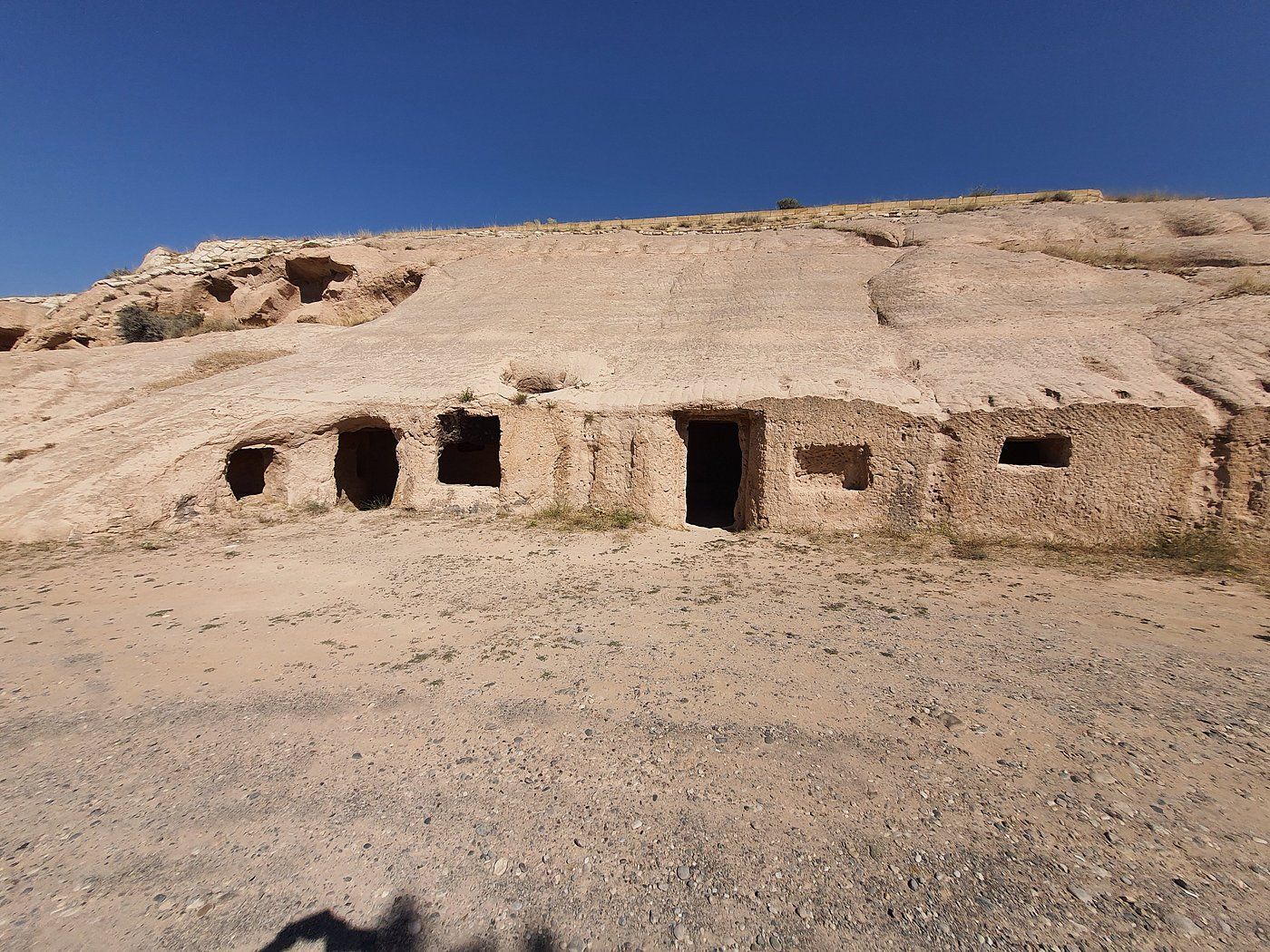
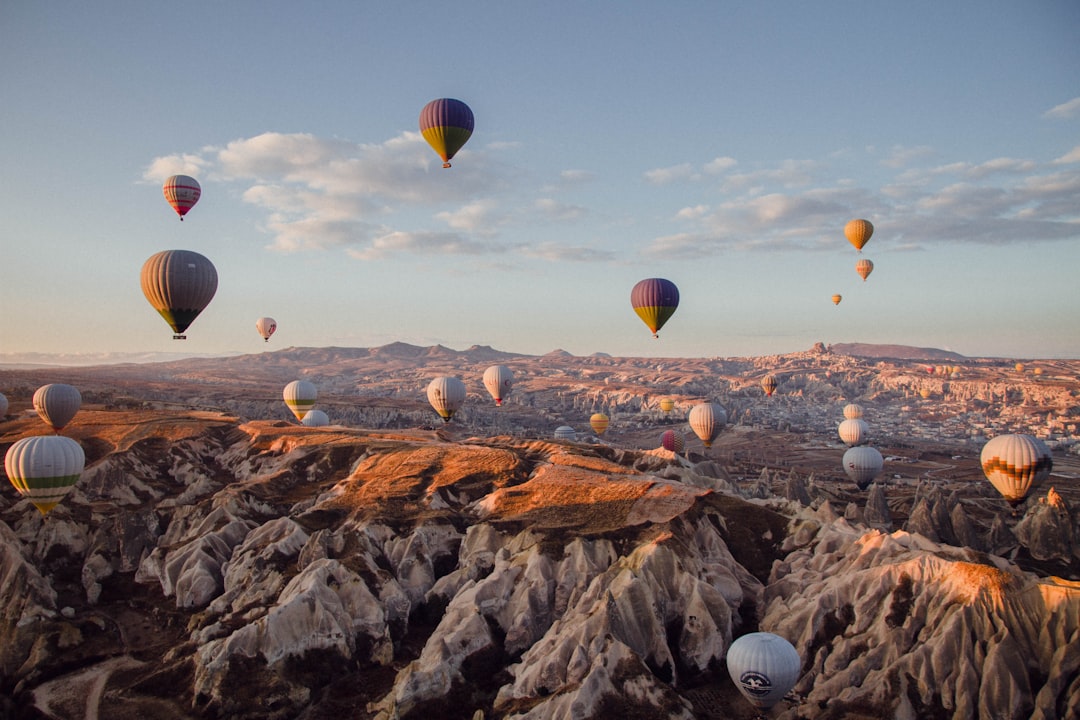
In Cappadocia's tradition of naming rock churches by their most striking visual feature — the Dark Church (Karanlık Kilise), whose windows were blocked to preserve pigment; the Apple Church (Elmalı Kilise), named for a painted orb that may be a globe or a piece of fruit; the Sandal Church (Çarıklı Kilise), marked by two footprint imprints in the floor — the Ala Church stands apart by its name alone. It did not take its identity from a saint's legend, a founding patron, or a liturgical dedication. It took it from colour. "Ala" means spotted, variegated, multicoloured. These were the churches whose interiors blazed with polychrome fresco programs so vivid, so all-encompassing, that the community simply called them "the Spotted One" — and the name held for a thousand years.
The Meaning of "Ala" in Turkish
The word ala carries considerable range in Turkish. A horse with a patchy, mixed coat is ala. A bird with mottled or dappled plumage is ala. An eye with unusual colouring, a fabric with irregular stripes, a sky crossed with clouds of different shades — all ala. The root idea is always the same: something that does not commit to one colour, something variegated, piebald, spotted with variety.
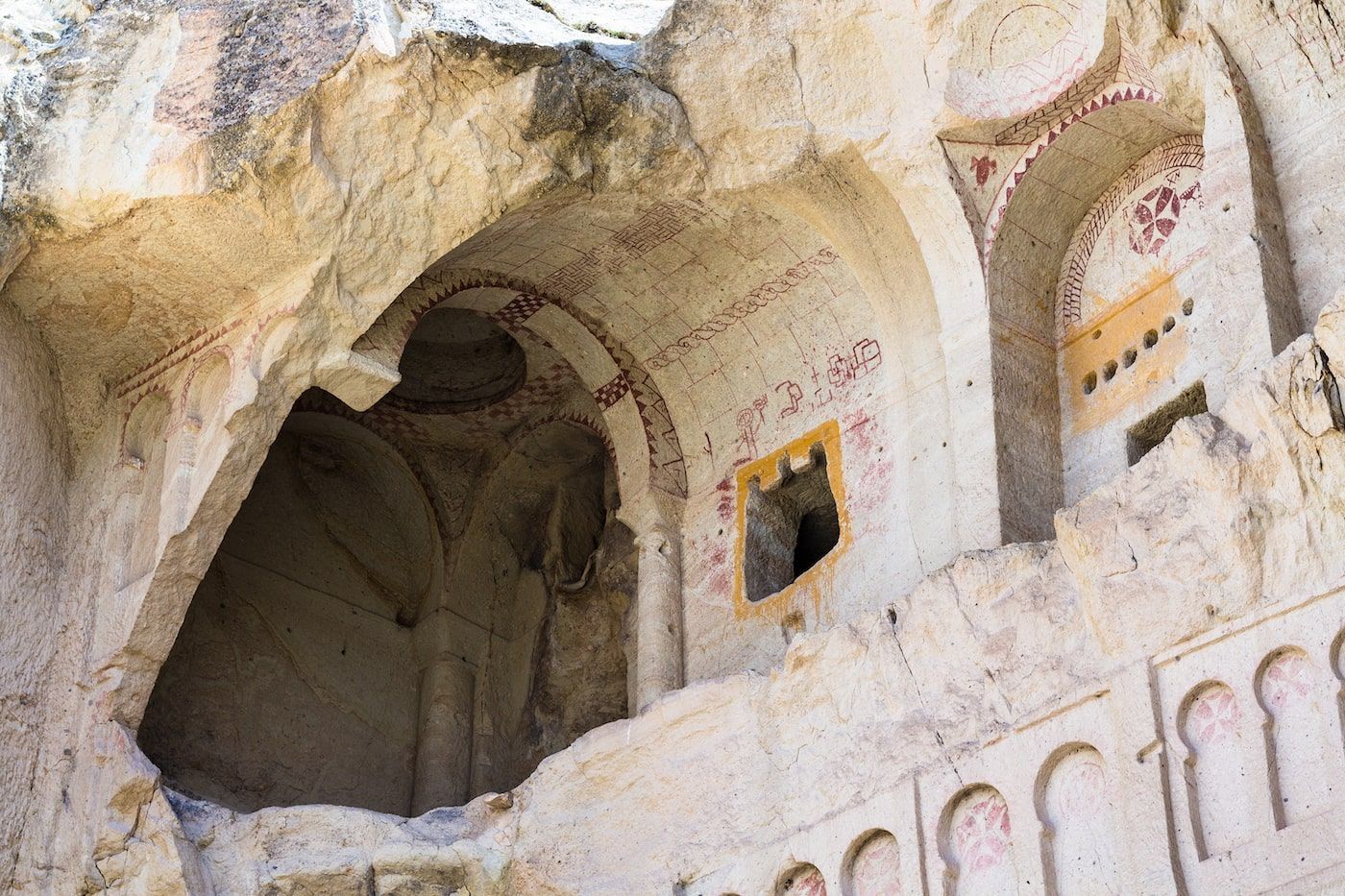
Applied to a Byzantine church carved from Cappadocian tuff, it describes the fresco program in a single word. When the Byzantines decorated a church, they did not leave surfaces plain. Every vault, every lunette, every column face and apse wall received pigment — deep crimson derived from iron oxide, ochre yellows, malachite greens, lead whites, and the deep blue of lapis where the budget allowed. A church so thoroughly covered that its interior shimmered with competing hues: that is an ala kilise. The naming tradition in Cappadocia is almost archaeological in its practicality. Official dedications — to Saint George, to the Archangel Michael, to the Forty Martyrs — survive in inscription when they survive at all. What the local community remembered, and transmitted, was what they could see: the dark one, the one with the apple, the one with the sandal prints, the spotted one.
The Güzelyurt Alaca Kilise
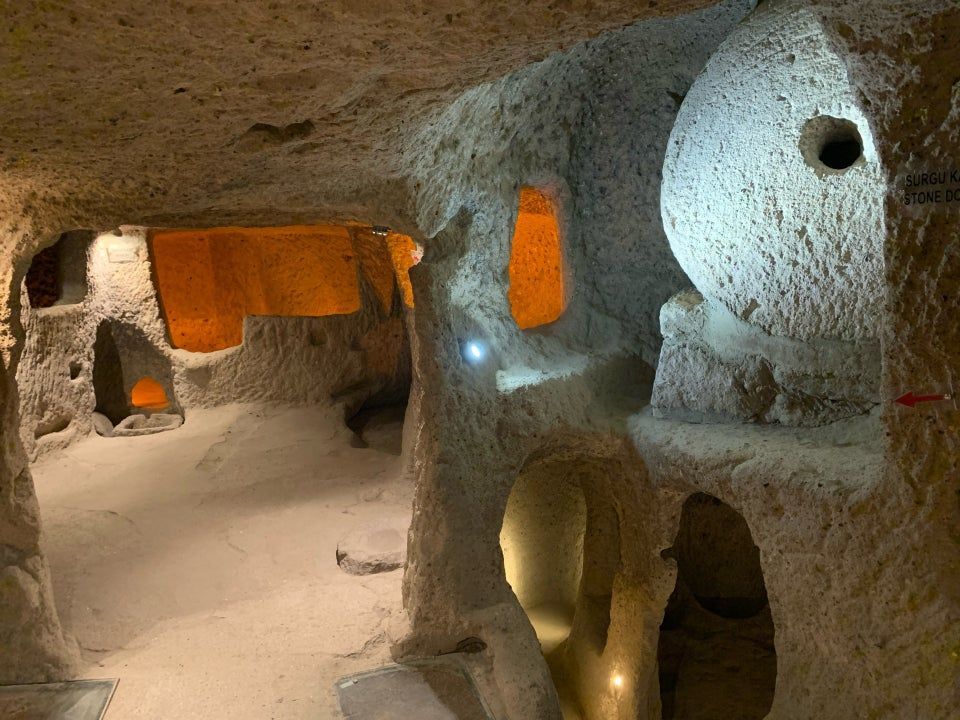
There are multiple churches across Cappadocia that carry the ala or alaca designation — the words are variants of the same root — but the most significant is typically associated with the Güzelyurt district, in the Peristrema region west of the Ihlara Valley. Güzelyurt, formerly known by the Greek name Gelveri and before that as Karbala, sits in a high volcanic plateau cut through by the Melendiz River system. The town itself is ringed by rock-cut monasteries, underground chambers, and cave churches that make it one of the most historically layered settlements in Cappadocia, though far fewer visitors reach it than reach Göreme.
The Alaca Kilise here is hewn from the soft Cappadocian tuff — the pale, workable volcanic stone formed from layers of ash deposited by eruptions of Erciyes and Hasan millions of years ago. The valley setting is unlike the lunar drama of the Rose Valley or the cone-studded horizons of Paşabağ. Here the landscape is greener: there are orchards and vegetable gardens watered by the river, willows along the banks, poplars in the autumn turning gold. The church sits within this texture, not above it — a carved interior embedded in a hillside, announced from outside by little more than a dark opening in the rock face.
Byzantine Architecture Carved in Stone
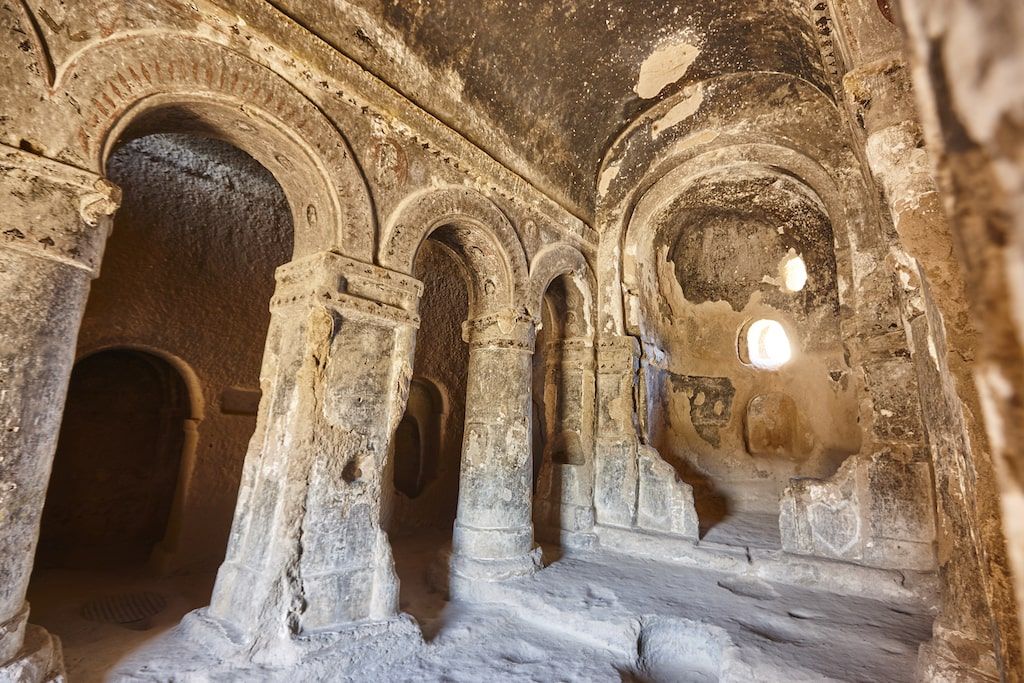
The church follows a plan common to Cappadocian rock-cut architecture: a single nave oriented east–west, with the apse cut into the eastern face to catch the light of the morning sun at the moment of consecration. What distinguishes the ala kilise from a purely utilitarian cave is the care taken to simulate the vocabulary of built Byzantine architecture in rock. The builders carved column forms from solid tuff — columns that do nothing structurally, since the vault above is a continuous mass of stone, but that visually articulate the nave in the way Constantinople's masonry churches would have done in marble. Capitals are suggested. Cornices are incised. The apse is defined by a recessed arch that mimics the triumphal arch of a basilica.
The effect, when you step inside and allow your eyes to adjust from the valley light, is of being inside a miniature version of a far grander building — a building whose model existed in the craftsmen's memory, transmitted from the great centres of Byzantine culture, and translated here into the medium available: volcanic tuff, iron-based pigment, and time.
The Fresco Program: What Makes It "Ala"
The frescoes are the reason the church is named at all. Byzantine theological aesthetics held that colour and light were not merely decorative but spiritually significant: the shimmering gold of a mosaic, the glowing reds of a painted robe, the cool blue of a heavenly background were understood as approximations of divine light made visible in material form. A well-decorated church was not merely an illustrated Bible — it was an attempt to make the sacred present through colour and form.
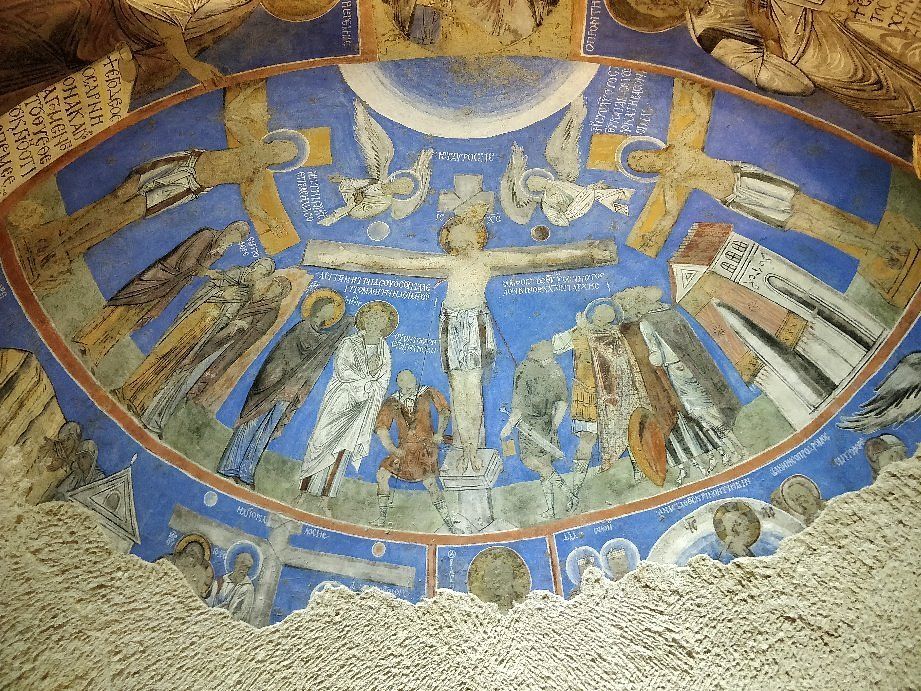
The iconographic program follows the hierarchy common to middle and late Byzantine decoration. The apse holds the most theologically charged image: Christ Pantocrator, the all-ruler, rendered in the dome of the half-sphere or enthroned in formal frontality. Below, the Virgin Theotokos — the God-bearer — is often present as intercessor. The nave vaults carry narrative cycles: scenes from the life of Christ moving from Annunciation to Nativity, Ministry, Passion, and Resurrection. The apostles appear in procession on the lower walls. The polychrome range — deep reds, warm ochres, muted greens, chalky whites, and occasional dark blues — is what earned the church its name. Standing inside, you are surrounded by colour on every surface. The stone itself has vanished behind pigment. You are inside the spotted church.
The Valley Setting and Its Surroundings
The landscape around the Güzelyurt Alaca Kilise rewards as much attention as the church itself. The Peristrema region is less visited than the Ihlara Valley gorge proper, which means that the stillness here is genuine. Birds nest in the tuff cliffs above the orchards — kestrels circling at the thermals, jackdaws calling from the carved openings in the rock faces. In spring, the valley floor runs with wildflowers: poppies, wild mustard, patches of mallow. In autumn, the orchards are heavy with apples, apricots, and quinces.
Other churches are within walking distance. The Güzelyurt district contains dozens of carved religious structures spanning several centuries of Byzantine use, and the Ihlara Valley gorge itself — a 14km canyon with some 105 carved churches — begins less than 20 kilometres to the south. A day spent moving between these sites, on foot along the river path in the gorge or by road between the upland villages, covers more Byzantine history per kilometre than almost anywhere else in Anatolia.
Visiting Practically
The Güzelyurt Alaca Kilise sits approximately 90 kilometres west of Göreme, making it a committed day trip rather than a quick excursion. The most practical approach is to combine it with the Ihlara Valley gorge walk, beginning at the valley's northern entry near Selime or the southern entry near Ihlara village, and including Güzelyurt as a detour. Access from Aksaray — the nearest large town — takes under 45 minutes by road.
- Distance from Göreme: approximately 90km west via Nevşehir and Aksaray
- Best combined with: Ihlara Valley gorge walk, Selime Monastery, Derinkuyu underground city
- Access: private vehicle or taxi — no direct public transport links the valley sites
- Facilities: none in the immediate valley; Güzelyurt town has basic cafes and a small market
- Water: carry your own, especially for valley walks in summer
Reaching Ala Church requires your own transport — use the Cappadocia taxi price calculator for fares from your hotel or from Göreme centre.
What to Look For Inside
Fresco pigments do not all survive equally. Iron-based reds and ochres are the most stable, which is why many Cappadocian churches appear predominantly warm-toned even when their original palette was far cooler. Look for the blues, which are often the first to fade or flake, and for the whites, which have frequently carbonated to a pale grey. In the apse, note the compositional hierarchy — the largest, most formally rendered figure occupying the central position, with smaller figures arranged in procession on either side.
The carved architectural details repay close attention: look at how the column capitals are rendered, whether they follow the Corinthian tradition or a simplified Byzantine variant, and note where the builders used the natural stratification of the tuff to suggest alternating bands of different stone — an effect that imitates the striped masonry of Byzantine buildings in Nicaea and Constantinople. Visitor etiquette here is the same as in any heritage site: do not touch the frescoes, avoid flash photography close to pigmented surfaces, and be aware that the floor level may be uneven where rock has worn or where earlier excavation has changed the original grade.
Frequently Asked Questions
Where exactly is the Ala Church (Alaca Kilise) in Cappadocia?
The most significant Alaca Kilise is located in the Güzelyurt district of the Peristrema region, approximately 90km west of Göreme and about 40km from Aksaray. It sits within the broader cluster of rock-cut churches that extends from Güzelyurt south through the Ihlara Valley gorge. The town of Güzelyurt — formerly Gelveri — is the nearest settlement with services.
What does "ala" mean and why is a church called that?
Ala is a Turkish word meaning variegated, spotted, piebald, or multicoloured — used for animals with mixed colouring and surfaces with irregular patterns. Applied to a church, it refers to a fresco program so richly polychrome that the building became identified by its colour. In Cappadocia, many rock-cut churches lost their official dedications over centuries; what survived in local memory was the most vivid physical feature — the dark one, the spotted one, the one with the apple. Ala Kilise or Alaca Kilise means "the Spotted Church."
Can I visit Ala Church independently, without a tour?
Yes, independent visits are possible, but you will need your own transport — there is no regular public bus service to the Güzelyurt Alaca Kilise. A rental car or private taxi from Göreme or Nevşehir is the practical option. The church is best combined with the Ihlara Valley gorge walk and Selime Monastery into a full day trip. Check opening hours and any entry requirements locally before visiting, as access to individual churches in this area can vary seasonally.